
Bolivia 8/10/26-12/10/26- Ruby Kick, October 2026
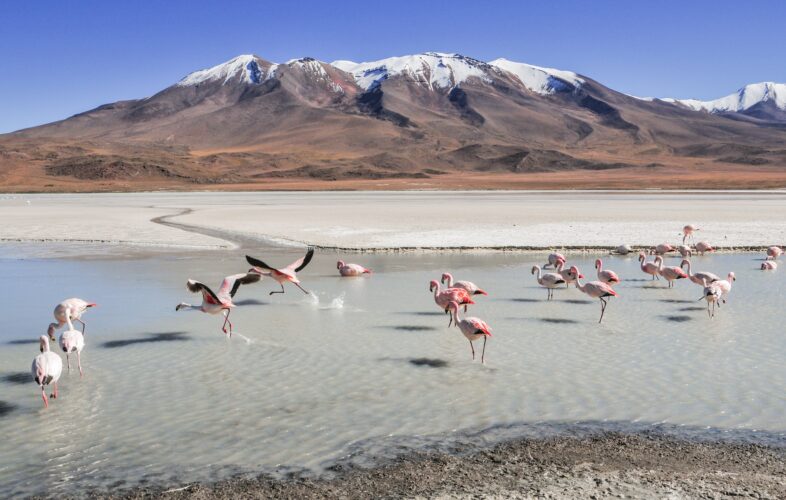
Me gustaría dedicar esta entrada por completo a nuestro reciente viaje al altiplano boliviano. El jueves anterior, nos embarcamos en nuestro viaje con mucha anticipación (una mezcla igual de emoción y nerviosismo ya que habíamos oído muchas historias de terror sobre la altitud). Dicho esto, llegamos muy preparadas con pastillas y mucho té local para aliviar los efectos. Volamos de Santiago a el desierto de San Pedro de Atacama, que está en el noreste de Chile y mejor conocido como el lugar más seco del mundo. Pasamos una noche allí, y a las cinco de la mañana el próximo día, fuimos a Bolivia con nuestra guía. Entre San Pedro y la frontera de Bolivia hay una pendiente de 2.080 metros en menos de 1 hora de trayecto, que termina a una altitud de 4.480 metros. Pero, para nuestra sorpresa, ninguna de nosotras sufrió efectos secundarios graves. Nuestro guía fue fenomenal en todos los sentidos de la palabra, nos dio una experiencia de tres días increíbles e inolvidables. Empezamos nuestro primer día pasando por el desierto de Dalí (el cual ganó este título a causa de sus paisajes y paletas de colores muy similares a los del artista surrealista de este nombre). En este parte de Bolivia, se nota lo diferente e igual de hermoso que es cada paisaje- nunca he visto (y dudo que vuelva a ver) un sitio que sienta tanto como si te hubiera sido insertado en una pintura.
Aunque solo estuvimos allí dos días completos, experimentamos muchísimo- lagunas, geíseres, volcanes, aguas termales, y el salar de Uyuni. Podría escribir una tesis completa sobre cada sitio que visitamos, pero voy a escoger los dos que me impresionaron en particular; la laguna colorada, y el salar de Uyuni (toda la información que yo he adquirido viene de nuestro guía). La laguna colorada es una visión de otro mundo- consiste en al menos tres colores (rojo, blanco, y verde), y obtiene su aspecto multicolor de una mezcla de sedimentos de minerales, microorganismos, y micro-algas. El blanco es causado por depósitos de bórax y sodio, mientras el verde es causado por diferentes especies de algas. Lo más guay (en mi opinión) es lo que causa el rojo. Dentro de la laguna hay una especie de plancton pigmentada que no solo produce el rojo profundo de la laguna, sino la rosa brillante de los casi cuarenta mil flamencos que viven en la laguna (al menos de manera estacional).
El otro sitio que debo incluir es el salar de Uyuni, el cual es lo más grande de todo el mundo, nunca había experimentado un espacio tan vasto en toda mi vida (crisis existencial pendiente). La mañana del domingo nos levantamos a las cuatro para llegar al salar a tiempo para el amanecer. Al salir el sol en el horizonte, fue una de las pocas vistas que realmente me dejaron sin aliento. En medio del salar hay una pequeña isla, Isla Incahuasi, donde se encuentra alrededor de 6 mil cactus. Cada cactus crece solo diez centímetros cada año, y algunos tienen una altura de más que nueve metros- así que tienen más que novecientos años! En fin, mi viaje a Bolivia fue una experiencia monumental y nunca me había sentido tan agradecida de tener la oportunidad de estar en este parte del mundo durante mi año en el extranjero.
—–
I would like to dedicate this entry entirely to our recent trip to the Bolivian altiplano. Last Thursday, we set out on our trip with lots of anticipation (an equal mix of excitement and nerves since we had heard a few horror stories about the altitude). With that said, we arrived very well-prepared with altitude sickness pills and local tea to alleviate the symptoms. We flew from Santiago to the desert of San Pedro de Atacama, which is in the Northeast of Chile and well-known as the driest place in the world. We spent one night there, and at 5am the following day we went to Bolivia with our guide. Between San Pedro and the Bolivian border, there is an incline of 2.080 meters in less than a one-hour drive, ending up at an altitude of 4.480 meters. But, to our surprise, none of us suffered severe side effects. Our guide was phenomenal in every sense of the word; he gave us an experience of three incredible, unforgettable days. We began our first day travelling through the desert of Dalí (which earned its name for its landscapes and colour palettes very similar to that of the surrealist artist of that name). In this part of Bolivia, you notice how different and equally beautiful each landscape is- I have never seen (and doubt I ever will again) a place that makes you feel so much as though you’ve been pulled into a painting.
Although we were only there for two full days, we experienced so much: lagoons, geysers, volcanos, thermal springs, and the salt flats of Uyuni. I could write an entire essay on each of the places we visited, but I’m going to pick two that particularly impressed me; laguna colorada (multicoloured lagoon), and the salt flats of Uyuni (all of the information that I have on these sites comes from our guide). La laguna colorada is otherworldly- it’s made up of at least three colours (red, white, and green) and it gets its multicoloured appearance from a mix of minerals, microorganisms, and micro-algae. The white is caused by deposits of borax and sodium, whilst the green is caused by different species of algae. The coolest (in my opinion) is what causes the red. Within the lagoon there is a specific species of pigmented plankton which not only causes the deep red in the lagoon, but also the bright pink color of the near 40,000 flamingos that live in it (at least seasonally).
The other site which I have to include is the salt flats of Uyuni, which is the biggest in the entire world. I had never experienced a space so vast in all of my life (existential crisis pending). The morning of the Sunday we got up at 4am to arrive at the salt flats in time for the sunrise. As the sun rose over the horizon, it was one of the few sights that has ever truly taken my breath away. In the middle of the salt flats there is a small island, Isla Incahuasi, which is home to around six thousand cacti. Each cactus only grows ten centimetres each year, and some are over nine meters tall- so they are over 900 years old! Overall, my trip to Bolivia was a monumental experience, I had never felt so grateful for this opportunity to be in this part of the world during my year abroad.